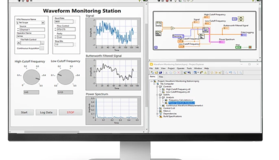
Virtual Instruments
李晴
目录
暂无搜索结果
1 Student Guide
1.1 Course Description
1.2 Course Goals
1.3 What You Need to Get Started
1.4 Study LabVIEW in MOOC
1.5 Teaching Documents
2 Introduction of LabVIEW
2.1 Student Guide
2.2 Introduction to LabVIEW
2.3 Parts of a VI
2.4 Dataflow
2.5 Example Code
2.6 Creating a new Project and VI
2.7 Knowledge Checks
3 Basic of LabVIEW programming
3.1 Student Guide
3.2 LabVIEW Programming Environment
3.3 LabVIEW DateTypes
3.4 Interface Design
3.5 Debugging Tools & Tips
3.6 Generate Applications and Installation Packages
3.7 Remote Release
3.8 Knowledge Checks
3.9 Exercise-bus Station
4 Loop Structure
4.1 Student Guide
4.2 While Loop
4.3 For Loop
4.4 Automatic Indexing
4.5 Shift Register
4.6 Formula Node
4.7 Exercise-Simple Calculator
4.8 Knowledge Checks
5 Arrays and Array functions
5.1 Student Guide
5.2 Introduction of Array
5.3 Array Elements&indexes
5.4 Array Creation
5.5 Common Array Functions
5.6 Array and Loop Structure
5.7 Array and Waveform
5.8 Sets of Data in LabVIEW
5.9 Working with Single Channel Acquisition Data
5.10 Working with N-channel Acquisition Data
5.11 Additional Array Examples
5.12 Knowledge Checks
5.13 Exercise-Lucky Draw
6 Cluster and Cluster Function
6.1 Student Guide
6.2 Reasons to Use Cluters
6.3 Creating a Cluster
6.4 Disassembling and Modifying Clusters
6.5 Exercise-Digital Tube Display
6.6 Error Clusters
6.7 Comparison of Arrays and Clusters
6.8 Knowledge Checks
7 Graphic Display
7.1 Student Guide
7.2 Waveform Chart
7.3 Waveform Graph
7.4 XY Graph
7.5 Intensity Graph and Intensity Chart
7.6 2D Image Manipulation
7.7 Using Cluters with Charts and Graphs
7.8 Knowledge Checks
8 SubVI
8.1 Student Guide
8.2 Understanding Modularity
8.3 Creating an lcon
8.4 Configuring the Connector Pane
8.5 Documenting a Subvl
8.6 Calling SubVls
8.7 Polymorphic VI
8.8 Re-entrant VI
8.9 Knowledge Checks
8.10 Exercise-NTC_Thermistor
9 Case Structures
9.1 Student Guide
9.2 Case Structure Introduction
9.3 Creating and Configuring Case Structures
9.4 Knowledge Checks
10 Sequence Structure
10.1 Student Guide
10.2 Sequence structure
10.3 Use Variable
10.4 Flat Sequence Structure
10.5 Stacked Sequence Structure
10.6 Data Transfer Between Frames in Sequence Structure
10.7 Invisible is Better than Tangible Sequence Structure
10.8 Knowledge Checks
10.9 Exercise-Traffic signal control system
11 State Machine
11.1 Basic Composition of State Machine
11.2 Custom Enumeration Constant
11.3 State Transition in State Machine
12 Producer-Consumer Structure
12.1 Producer-Consumer Cycle
12.2 Composition and Structure
12.3 Creating and Function
12.4 Producer-Consumer (events)
12.5 Producer-Consumer (data)
12.6 Appliance
13 Basic Timing Funciton
13.1 Student Guide
13.2 Timing Funciton
14 Data Acquisition
14.1 NI DAQ
14.2 Temperature Acquisition
14.3 Data Acquisition System Basics
14.4 Serial Device Usage
14.5 Knowledge Checks
15 Data Communication
15.1 Global Variables and Functional Global Variables
15.2 Attribute Nodes
15.3 Call Nodes
15.4 Queues
15.5 Object-oriented Programming
15.6 VI Server
15.7 External Program Interface
16 Project Design and Development
16.1 Remote Temperature Detection System
16.2 Smart Traffic Light Control System
16.3 Performance Test Systems for Electrical Equipment
16.4 Smart Home System
16.5 Oscilloscope Information Acquisition System
16.6 Simple Parking Management System
17 Display of Students' Works
17.1 Intimate Emotional Instrument
17.2 Vaccine Cold Chain Storage and Transportation Vehicle
17.3 Intelligent Tea Maker
17.4 Smart Belt
17.5 Forest Train Prevention
17.6 Intelligent Pet Collar
17.7 Smart Home System
17.8 Intelligent Medical Care System
17.9 Sensor Pocket Laboratory
17.10 Intelligent Music Player
17.11 Body Fat Scale
17.12 Design of Monitoring System for Lily Greenhouse Based on Arduino
LabVIEW Programming Environment
1
video
2
ppt
上一节
下一节
选择班级
确定
取消
图片预览